

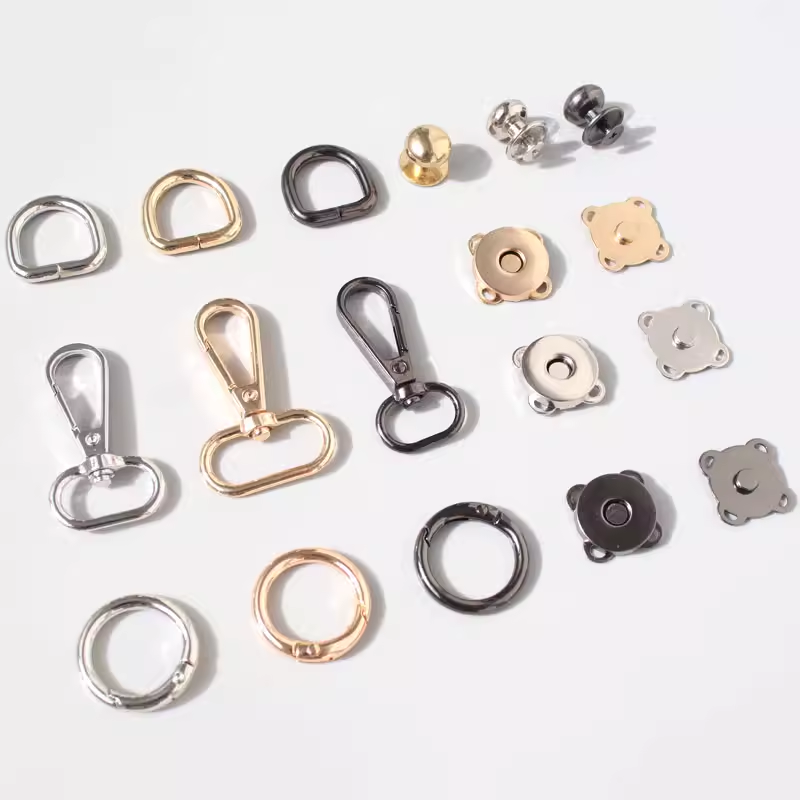
Apart from the common zinc alloy, bag hardware also uses brass, stainless steel, iron/steel, aluminum alloy, and a few high-end materials (e.g., titanium alloy, silver). Each material differs significantly in cost, feel, durability, and workability. Below is a breakdown to help you choose based on bag positioning and budget.
1. Zinc Alloy
Most popular, best value for money – the go-to for mid-to-high-end bags (from dozens to a few hundred USD).
✅ Advantages:
Excellent plasticity: die-cast into complex, detailed 3D shapes (embossed logos, decorative buckles).
Good plating results: can be plated in gold, gunmetal, antique brass, etc., with a smooth finish.
Moderate cost: cheaper than pure brass, more corrosion-resistant than iron.
❌ Disadvantages:
Brittle: can crack or break under strong impact or bending (especially thin-walled parts).
Dense and heavy: large hardware pieces (e.g., big locks) add noticeable weight.
Once plating is damaged, the base oxidizes into a grey-white powder (commonly called “blistering”).
2. Brass (Pure brass or copper alloy)
High-end, vintage, the king of texture – often used in luxury brands (e.g., Hermès, some Louis Vuitton).
✅ Advantages:
Naturally corrosion-resistant: even without plating, it develops a warm patina over time (aged look).
Good balance of hardness and toughness: not brittle, can be forged into fine geometric shapes.
Feels warm and heavy, with a crisp, pleasant sound when tapped.
❌ Disadvantages:
Expensive: material cost 3–5x that of zinc alloy; mostly forged or CNC machined – labour-intensive.
Heavy: denser than both stainless steel and aluminum alloy.
Unplated brass oxidises to dark brown/black (some like it, others see it as a flaw).
3. Stainless Steel (mainly 304/316)
Strong, durable, modern look – common in streetwear, tech-wear, outdoor bags.
✅ Advantages:
Very high hardness: resists scratching, deformation, and breakage.
Excellent corrosion resistance: no plating needed; natural silver-grey finish, unaffected by sweat or moisture.
Can be brushed, mirror-polished, or PVD-coated (black, gold, etc.).
❌ Disadvantages:
Hard to work: cannot be die-cast into complex shapes; mostly stamped, welded, or CNC machined – less detailed than zinc alloy.
Heavy: density similar to zinc alloy, but often made thicker, making it even heavier.
Cold, hard feel: lacks vintage warmth – not suitable for elegant bag styles.
4. Iron / Carbon Steel (plated)
Low-end, cheap hardware – found in sub-$15 bags, promotional giveaways.
✅ Advantages:
Extremely low cost: cheap material, mass-produced by stamping.
High strength: resists deformation.
❌ Disadvantages:
Very prone to rust: once the plating has micro-pores or scratches, the inside rusts quickly (red rust spreads).
Poor finish: plated surface often has orange-peel texture or pitting.
Not suitable for complex shapes – mainly simple buckles, D-rings.
Not recommended for any bag of reasonable quality.
5. Aluminum Alloy
Lightweight, modern, sporty – often used for corners, handles, locks on suitcases and travel bags.
✅ Advantages:
Extremely light: density ~1/3 of zinc alloy – adds little weight even on large bags.
Anodizable: can be made in black, silver, red, blue, etc., colour will not fade.
Does not rust.
❌ Disadvantages:
Relatively soft: surface easily dented or scratched (unless hard-anodized).
Feel is more “plasticky metal” – lacks the hefty premium feel.
Casting precision lower than zinc alloy – less detail possible.
6. Titanium Alloy
Ultra-light, ultra-strong, ultra-expensive – used in top-tier luxury or specialty bag hardware (e.g., business carry-on locks).
✅ Advantages:
Excellent strength-to-weight ratio: harder than stainless steel, lighter than aluminum.
Biocompatible, absolutely corrosion-resistant (unaffected by salt water, sweat).
Surface can be fine-blasted or colour-anodized.
❌ Disadvantages:
Extremely high cost: expensive material and difficult to machine (special tools needed) – multiple times more expensive than brass.
Limited colours: usually silver-grey or rainbow-tone (from anodizing) – lacks warm gold/antique looks.
7. Silver / Sterling Silver
Very niche – mostly used for decorative parts (e.g., silver clasps, logos) on handmade leather goods or art bags.
✅ Advantages:
Unique warm silver-white lustre; tarnishes but can be polished back.
Can be hand-engraved with extremely fine details.
❌ Disadvantages:
Too soft: deforms easily under stress – not suitable for structural parts.
Expensive, tarnishes quickly (needs frequent polishing).
Summary: Which Material for Which Bag Positioning?
| Bag Positioning | Recommended Material | Reason |
|---|---|---|
| Luxury (US$1000+) | Brass (forged + thick gold plating) | Best feel, heirloom quality, patinas beautifully |
| Mid-to-high (US$100–300) | Zinc alloy (real gold plating) | Rich shapes, great value, acceptable weight |
| Streetwear / Tech / Outdoor | Stainless steel, Aluminum alloy | Durable, rustproof, modern look |
| Accessible / Designer niche | Zinc alloy + some brass mix | Balances cost and quality |
| Fast fashion / under US$15 | Zinc alloy (standard plating) | Better than iron; check plating quality |
| Never buy | Iron / Carbon steel (plated) | Rusts quickly, discolours, can scratch leather |
One‑sentence advice
- Best durability, don’t mind weight → Brass
- Best detailed shapes, moderate budget → Zinc alloy (choose thick plating)
- Lightweight, outdoor look → Aluminum alloy
- Minimalist, hard‑wearing, no fading → Stainless steel